

Free-Space Optical Communications Research
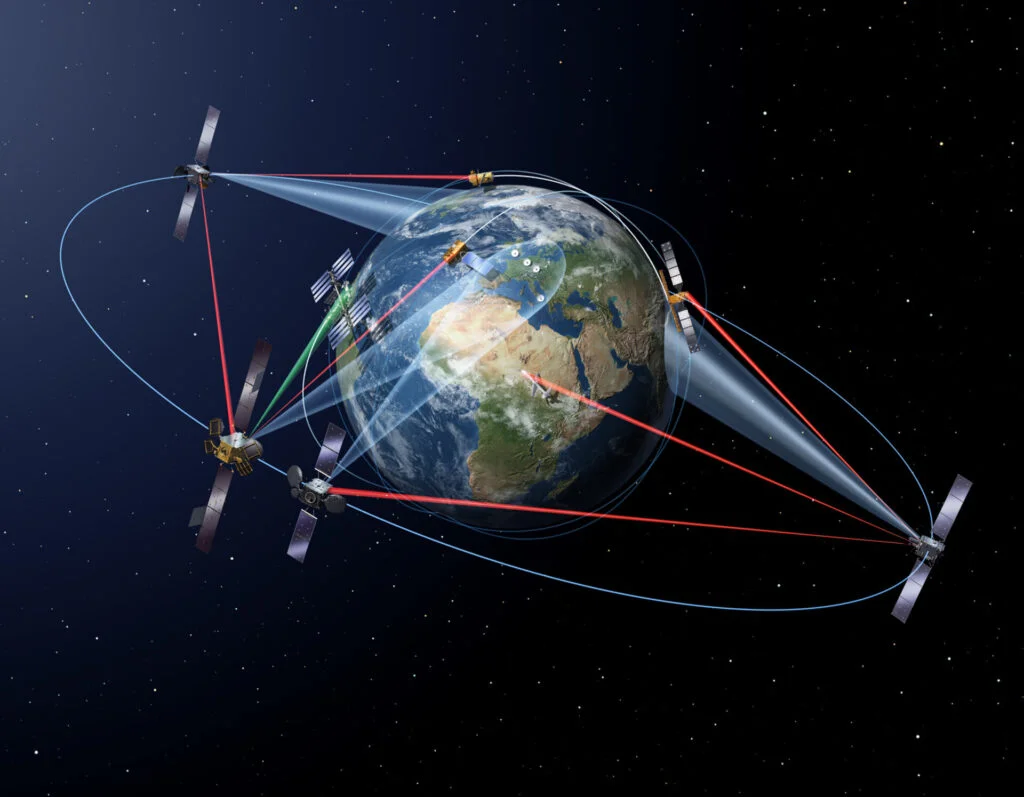
Free-Space Optical (FSO) communications technology uses laser beams transmitted through the atmosphere or space to achieve ultra-high-bandwidth, secure, low-latency data links. ASTI conducts applied FSO research for satellite communications, inter-spacecraft links, ground-to-space connectivity, and terrestrial last-mile broadband applications.
What is Free-Space Optical Communications?
FSO systems transmit data using modulated laser or LED light propagating through free space rather than fiber-optic cables or radio waves.
This approach offers significant advantages including:
• Extremely high data rates (multi-gigabit to terabit-per-second potential)
• Narrow beam divergence enabling secure point-to-point links
• Immunity to radio frequency interference and spectrum congestion
• Unlicensed spectrum operation in optical bands
• Low size, weight, and power (SWaP) compared to equivalent RF systems
FSO is critical for next-generation satellite constellations, deep space communications, military secure data links, and high-throughput connectivity in spectrum-constrained environments.
Challenges include: atmospheric turbulence and scattering, weather sensitivity (clouds, fog, rain), precise pointing and tracking requirements, and terminal alignment and stabilization.
ASTI's FSO research addresses these challenges through adaptive optics, atmospheric modeling, robust modulation and coding schemes, acquisition and tracking systems, and hybrid FSO-RF architectures.
ASTI FSO Research Capabilities
ASTI develops FSO systems and subsystems for space and terrestrial applications:
Optical Transmitters and Receivers Design and characterization of laser sources, optical modulators, photodetectors, and receiver optics optimized for long-distance FSO links.
Pointing, Acquisition, and Tracking (PAT) High-precision PAT systems enabling sub-microradian pointing accuracy for satellite-to-satellite and ground-to-space FSO terminals.
Atmospheric Propagation Modeling Analysis of turbulence effects, scintillation, beam spreading, and atmospheric absorption to predict FSO link performance and develop mitigation strategies.
Adaptive Optics Wavefront sensing and correction techniques to compensate for atmospheric distortion and improve link availability and data rates.
FSO Terminal Integration End-to-end FSO terminal design, integration, and testing for CubeSats, small satellites, ground stations, and mobile platforms.
Hybrid Communications Systems Architectures combining FSO and RF links to leverage FSO's high bandwidth while maintaining RF backup for weather-impaired conditions.
ASTI collaborates with satellite manufacturers, space agencies, defense organizations, and telecommunications providers to advance FSO technology readiness and deploy operational systems.
Partnership Opportunities
We welcome partners focused on:
• Satellite-to-satellite optical crosslinks
• Ground-to-space FSO terminals and networks
• Atmospheric propagation research and modeling
• Adaptive optics for communications
• FSO for military and intelligence applications
• Commercial FSO broadband systems
• Deep space optical communications
Contact ASTI
Explore FSO research collaboration with ASTI. Contact contact@asti.technology to discuss optical communications projects, access our laser communications testing facilities, develop custom FSO terminals, or advance atmospheric propagation research.